Objects That Make Statements
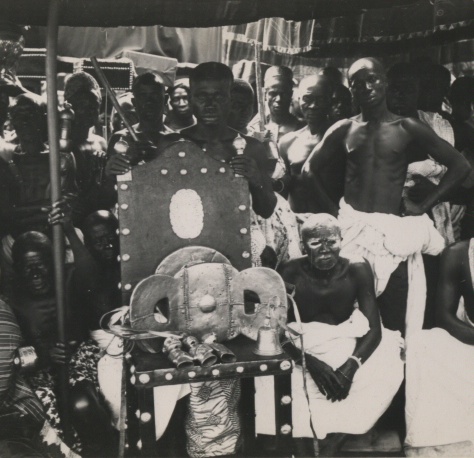
An Asante chief in procession is surrounded by objects, and to an uninformed onlooker the effect is simply one of splendour. To an Asante audience it is closer to reading. Almost every item — the umbrella above the chief, the swords carried before him, the staff held by his spokesman, the cloth he wears, the sandals on his feet — states something specific about rank, office, history or obligation. Regalia in Asante is a communicative system, and the sayings it encodes are largely proverbial.
The State Umbrella
The great umbrella, kyinie, is the most conspicuous element. It is far larger than a practical sun-shade, made of patterned cloth over a wooden frame, and carried by a bearer who spins and pumps it rhythmically as the chief moves, so that it rises and falls above the procession. Umbrellas are graded: their size, the richness of their covering and their number all mark the standing of the person beneath.
The finial on the top — a carved wooden figure, often gilded — is where the specific statement is made. A finial may be an animal, a hand, a fruit, a knot, or a small scene, and each refers to a proverb or an attribute claimed by the office. Two chiefs' umbrellas may be equally splendid and say quite different things.
Swords
Court swords are not weapons. Their blades are typically iron, sometimes pierced with decorative openwork, and their hilts are wooden and wrapped in gold leaf. They are carried in procession, used to swear oaths, sent as tokens of authority with a messenger, and displayed in state.
The best-known category is the akrafena, the "soul sword", associated with the soul of the chief and with purification rites; a corresponding set is associated with the bosom, the personal spirit. Other swords are carried by particular officials, or attached to particular duties such as the swearing-in of a subordinate chief. Attached to many state swords is a cast gold or gilded ornament, an abosodeɛ, whose form again encodes a proverb — a well-known example being a coiled snake with a bird, referring to a saying about an unusual and remarkable event.
A sword sent by the Asantehene with a messenger carried his authority. The object functioned as credentials, and a message delivered with the sword was to be treated as coming from the ruler himself.
The Linguist's Staff
The okyeame — usually translated "linguist", more accurately a spokesman and counsellor — is a court official through whom formal speech to and from the chief passes. He is not an interpreter of language but a mediator of address: it is improper to speak directly to a chief in formal proceedings, and the okyeame carries the words in both directions, often reformulating them with greater eloquence.
His badge of office is the staff, okyeame poma: a wooden pole, usually gilded, topped by a carved finial. The finial is almost always a proverb rendered in three dimensions. Recurring examples include:
- two men at a table with food, referring to a saying about food belonging to the one entitled to it;
- a hand holding an egg, on the delicacy required in the exercise of power — grip too hard and it breaks, too loosely and it falls;
- a bird turning its head backwards, associated with the idea of returning for what has been forgotten;
- a spider or a knot, on wisdom and on problems that cannot be untangled by one party alone.
The staff is held up during proceedings, and its proverb comments on the occasion. Interpretations of individual staffs vary and multiple readings of the same image circulate; the meanings are conventional and known, but they are not a fixed dictionary.
Origins and Change
Not all of this is equally ancient. Gold-headed staffs of the linguist type appear to have taken their present form in the eighteenth and nineteenth centuries, and the influence of European canes and staffs of office presented in coastal diplomacy is generally acknowledged, as is the influence of European ceremonial on some other regalia forms. The proverbs and the office of okyeame are older than the objects that now signify them; the material culture absorbed foreign forms and gave them Asante meanings. That is a normal process, and the tendency to describe all regalia as timeless obscures it.
Reading It Today
The system is still in use. At Odwira, at Adae ceremonies and at the funerals and installations of chiefs, umbrellas, swords and staffs are deployed exactly as they were, and the statements they make about precedence still matter. In museum cases the same objects are usually shown without their proverbs, which reduces them to fine goldwork. Anyone looking at Asante regalia in a European collection — and Dutch collections hold a good deal of it — is seeing one half of an object whose other half is a sentence.