Drums That Speak
The phrase "talking drums" is often used loosely for any African drum, and just as often misunderstood as a kind of code, like Morse. The atumpan of Asante are neither. They are speech surrogates: instruments that reproduce the actual sound-shape of the spoken language closely enough for a listener who knows the language to hear words.
This works because Twi is a tonal language. The pitch on which a syllable is spoken is part of its identity, and two words made of the same consonants and vowels can differ in meaning according to their tone pattern. A drum that can produce two distinct pitches can therefore reproduce the tonal contour of an utterance, and combined with its rhythm — the pattern of long and short syllables — this gives a listener a great deal to work with.
The Instruments
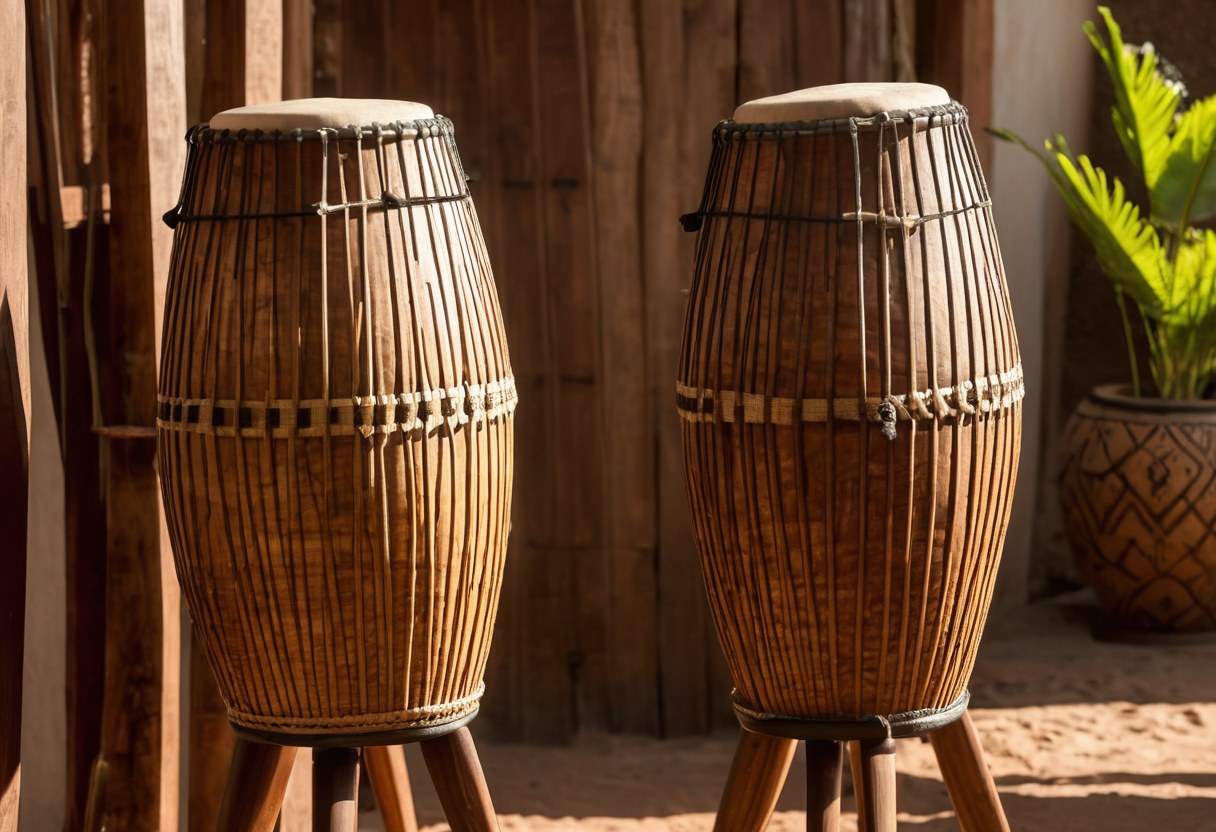
Atumpan are played as a pair: two tall, open-bottomed drums with carved wooden bodies and skin heads, standing at an angle on a support so that the player can reach both. One is tuned higher than the other, and the pair is conventionally described as male and female. The drummer strikes with a pair of curved sticks, and by striking different areas of the head and using different techniques can produce more than the two basic pitches.
The drums are made from a single hollowed section of hardwood, carved in one piece, with the head pegged and tensioned. They belong to the court and to important stools, and are themselves treated as objects of consequence rather than as ordinary instruments.
What Is Drummed
Drummed language is not everyday speech transferred to a drum. It is a formal register with its own conventions, and it consists largely of set texts:
- praise names and appellations of the Asantehene, chiefs and stools;
- proverbs and formulaic sayings;
- historical references — the names of past rulers, the recollection of events;
- announcements of arrival, assembly and the opening of proceedings;
- invocations addressed to the ancestors and to the spirits associated with the drum and its materials.
Because the tonal pattern of a short phrase can be ambiguous, drummed texts use redundancy: a name is expanded into a longer standard phrase whose overall contour is unmistakable. This is how the ambiguity problem is solved in practice, and it is why drum texts sound elaborate and poetic rather than terse.
The Awakening
The best-known drum text is the one performed at the beginning of a major occasion, in which the drummer addresses the components of the drum — the tree from which it was made, the elephant whose hide covers it, the wood-carver — and calls the ancestors and the spirit of the drum to attention before any other message is sent. It is a formal opening, and it establishes that what follows is court speech, not entertainment.
The Drummer
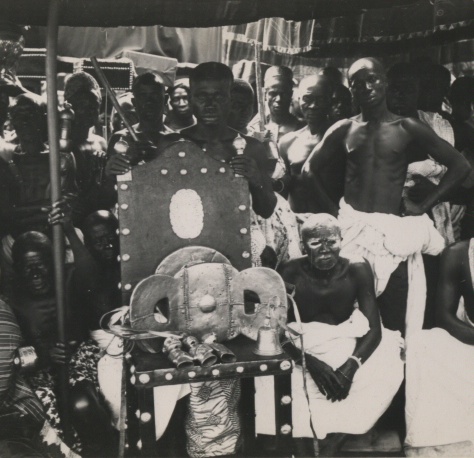
The court drummer is an officeholder, not a performer engaged for an occasion. The position carries responsibility for a repertory that must be transmitted accurately, since the texts are historical record as well as ceremony. Training is long and takes place by apprenticeship, and it involves learning the language of the drums as a body of knowledge — who is entitled to which appellation, what is drummed on which occasion, and in what order.
Distance and Its Limits
Atumpan carry a considerable distance in the right conditions, and relaying between villages was possible, which is the origin of the European fascination with drums that seemed to transmit news faster than a messenger could walk. The reality is more prosaic and more interesting: the range is limited by terrain and weather, and the primary use of the atumpan was never long-distance telegraphy but ceremony at a chief's court, where the drums announce, praise, and mark the stages of proceedings.
Study and Continuity
The academic study of Asante drum language was placed on a firm footing by the Ghanaian musicologist J. H. Kwabena Nketia, whose work on drumming and on the relationship between speech tone and drum text remains the standard reference. That scholarship matters practically as well as academically: it documents a repertory that depends on unbroken transmission.
Atumpan are still played at Asante courts and festivals, and their sound remains one of the immediate markers that a chief is present and that proceedings are formal. They are also now heard in concert halls and recordings, where the texts are usually inaudible to the audience as language — which is a reminder that the drums are not primarily musical instruments at all, but a way of speaking.