History of the Tropenmuseum
The Tropenmuseum (Tropical Museum) was founded in 1864 as the Colonial Museum of Haarlem, initially serving to educate the Dutch public and trade community about colonial possessions and tropical commodities. It moved to Amsterdam in 1926, occupying its current landmark building in the Oosterpark district. In 2014 it merged with the Afrika Museum (Berg en Dal), the Museum Volkenkunde (Leiden), and the Wereldmuseum (Rotterdam) to form the Nationaal Museum van Wereldculturen (NMVW).
The institution holds approximately 400,000 objects and 700,000 photographs in its total collection, making it one of the largest ethnographic museums in the world. The West African and specifically Ghanaian/Asante holdings represent a significant sub-collection.
The Asante Holdings: Key Categories
Royal Regalia and State Objects
The most culturally significant items in the collection include objects associated with Asante royal authority. These encompass:
- Akrafena (swords of state): Elaborately decorated swords carried by royal sword-bearers (afenasoafo) as symbols of chiefly authority. Several Asante akrafena in the NMVW collection have gold-leaf decorated handles and blades with distinctive curved tips.
- Fontomfrom drums: Large royal drums used at court ceremonies. Their possession and use was restricted to paramount chiefs and above.
- Umbrella tops (kyinie tiakyi): The elaborate carved and gilded finials from royal umbrellas, which served as important state symbols at public processions.
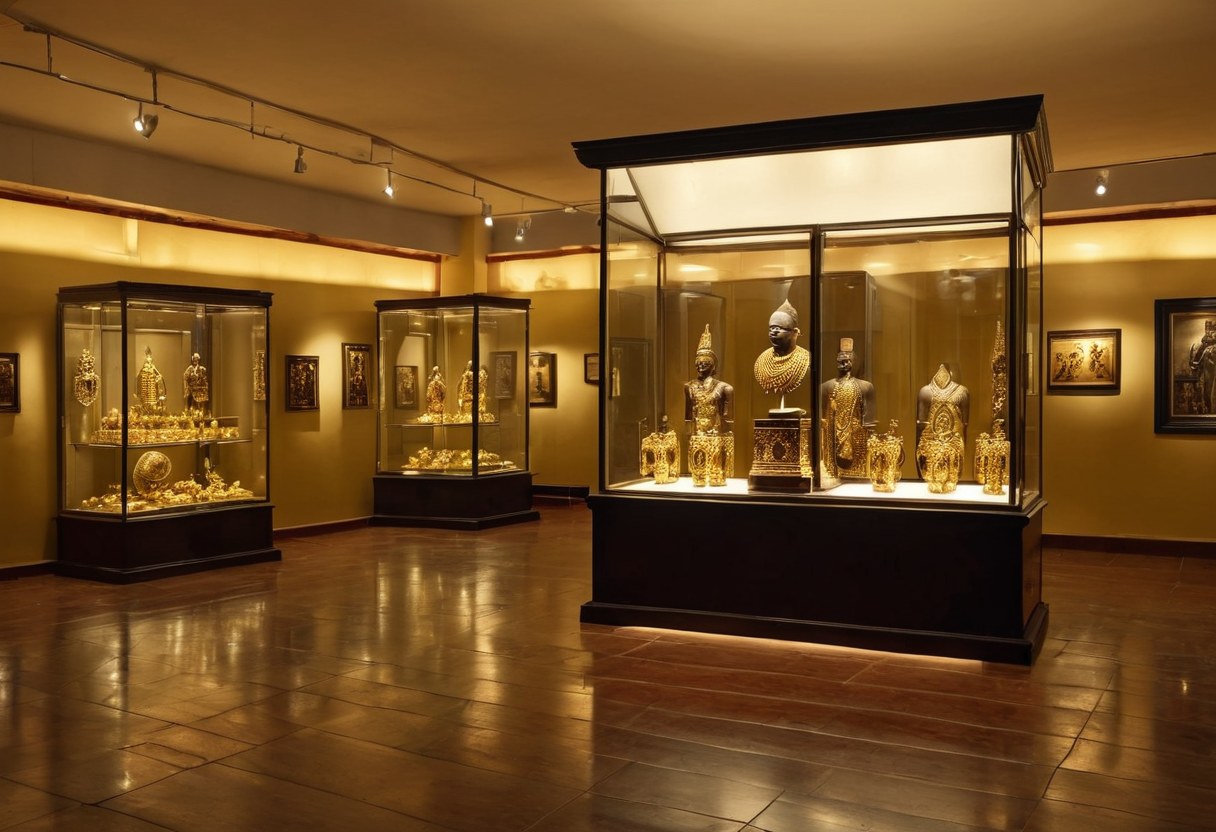
Gold and Goldwork
Asante goldsmiths were among the most skilled in the world, and the NMVW holds a significant collection of Asante gold objects:
- Gold weights (abrammuo): Brass geometric and figurative weights used with gold-dust scales. The NMVW holds examples from the 17th–19th centuries.
- Gold jewellery: Necklaces, bracelets, and pendants demonstrating the sophistication of Asante cast-gold techniques.
- Gold pectorals (akrafokonmu): Disc-shaped chest ornaments worn by soul-washers (akrafo) in the royal court.
Textiles
The collection includes examples of kente cloth woven in the traditional narrow-band technique, including rare examples of asasia, the finest grade of kente reserved for royal use. Also present are adinkra cloth examples with stamped symbolic patterns.
Ritual and Ceremonial Objects
Objects relating to Asante spiritual practice include abosom (deity) shrines, suman (personal protective charms), and objects associated with the asantehemaa (queen mother) court.
Provenance and Acquisition History
The collection was assembled through multiple channels over nearly two centuries. Some objects were acquired through legitimate trade or diplomatic exchange; others entered the collection under more questionable circumstances. The museum's provenance research programme, which began in 2020, has catalogued the acquisition history of several hundred objects, identifying a significant number whose circumstances of acquisition require further investigation.
Public Access and Research
The Tropenmuseum maintains an online collection database at collectie.wereldculturen.nl where many Asante objects can be accessed with images and partial provenance information. Researchers with institutional affiliation can arrange access to the physical collection. The museum also maintains exchange programmes with Ghanaian scholars and cultural institutions.
The Repatriation Context
As part of the NMVW, the Tropenmuseum has been central to the Dutch repatriation debate. The museum's director has publicly acknowledged that some objects in the collection were acquired under colonial coercion and has expressed willingness to return items to Ghana upon formal request supported by the Dutch government's advisory framework. Several Asante objects are currently under active review as potential repatriation candidates.