A Palace That Became a Museum
The building that houses the Manhyia Palace Museum was put up in 1925 as a residence for Asantehene Prempeh I, who had returned to Kumasi the previous year after almost three decades of exile — first in Sierra Leone, then in the Seychelles. It served as the seat of the Asantehene until 1974, when Opoku Ware II moved into a new palace on the same grounds. The old building was opened to the public as a museum in 1995, during the silver jubilee of Opoku Ware II's reign.
That history is not incidental. The museum occupies a house built for a king brought back from exile by the power that had deposed him, and it now presents the continuity of the Asante state to Ghanaians and to visitors. The institution is itself an argument about survival.
What the Museum Holds
Regalia and state objects
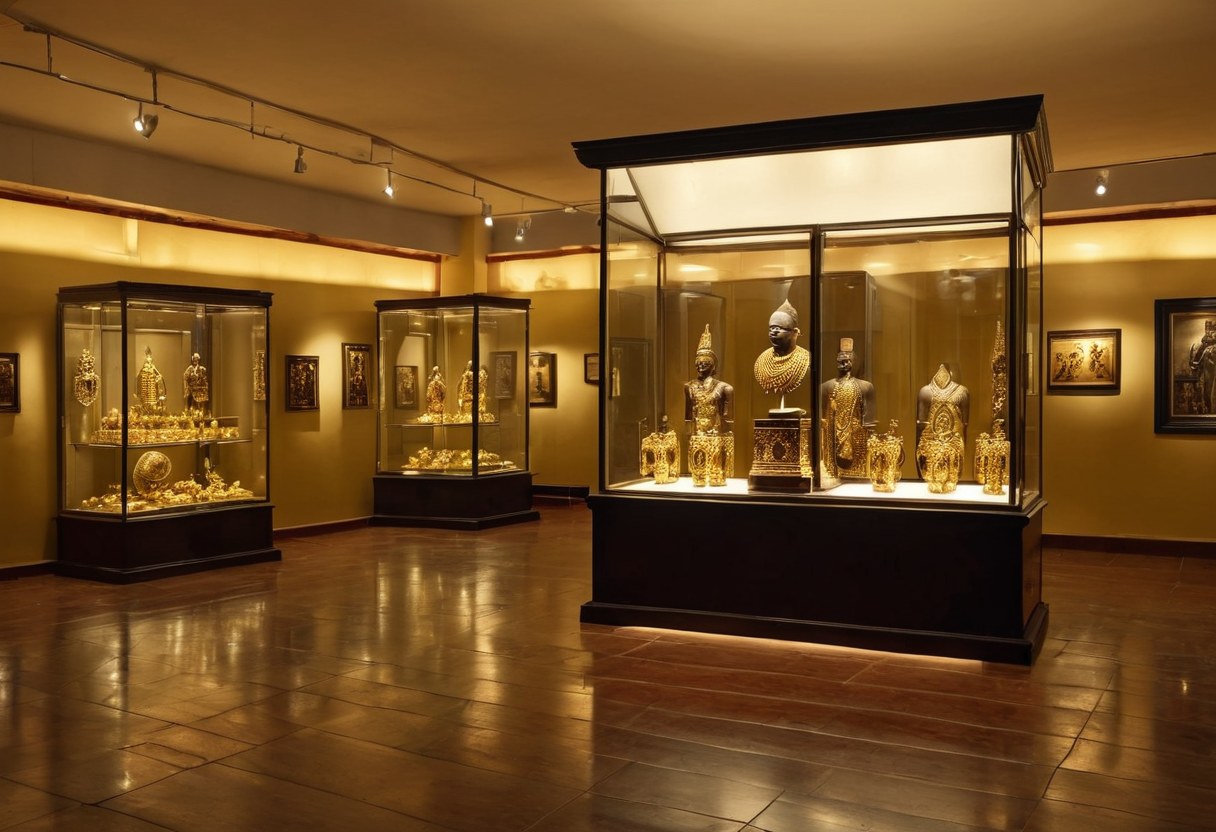
The collection includes swords of state, gold ornaments, linguist staffs, stools, umbrella finials and the personal effects of successive Asantehenes and Asantehemaa. Because these are the possessions of a living institution rather than objects collected by outsiders, they are displayed with the names, offices and occasions attached to them — information that is frequently lost from objects held abroad.
Photographs and furnishings
The interiors preserve the furniture, portraits and household objects of the twentieth-century palace, and the photographic holdings document royal ceremony, state visits and family life across a century. For historians of the colonial and post-colonial period the photographs are a significant and under-used source.
Oral and documentary records
Alongside the displays the palace maintains records of Asante tradition: stool histories, genealogies, the texts and protocols of ceremony, and correspondence from the twentieth century, including material relating to the restoration of the Asante Confederacy in 1935 and to the relationship between Manhyia and successive Ghanaian governments. Access to this material is not the same as access to the galleries; researchers approach it through the palace and by permission.
Renovation and Return
The museum was substantially refurbished and reopened in the mid-2020s in connection with the silver jubilee of Asantehene Otumfuo Osei Tutu II, with new interpretation and improved display conditions. That work coincided with its emergence as a destination for objects coming back to Kumasi.
In 2024 gold regalia taken from Kumasi in the nineteenth century went on display at Manhyia under agreements with British institutions. Crucially, these were long-term, renewable loans rather than transfers of ownership: British legislation governing the national museums restricts their ability to give objects away permanently, and the loan mechanism was the route available. In the same period a United States university museum transferred ownership of a small group of Asante royal items outright. The contrast between the two arrangements — borrowed back versus given back — is the sharpest illustration available of where the restitution question currently stands.
Visiting
The museum stands on the Manhyia palace grounds in Kumasi and is open to the public. Guided tours are the normal way of seeing it, and the guides carry a great deal of the interpretation, which is worth knowing if you are used to reading labels and moving on. Photography inside the galleries is usually restricted. Because the palace is a working royal residence, access and timings can be affected by ceremonial occasions; visitors planning a trip around a specific date should check ahead. Anyone in Kumasi for the Akwasidae will find that the festival and the museum illuminate each other.
Using the Museum as a Researcher
- Ask in advance for anything beyond the galleries. Research use of palace records is granted by permission and takes time to arrange; a clear written statement of your topic and purpose is essential.
- Respect the difference between public and restricted knowledge. Some ritual and stool matters are not public and are not withheld arbitrarily. A researcher who accepts that boundary will generally be told a great deal more than one who does not.
- Treat the guides as informants. The tour narrative is the kingdom's own account of its past, and its emphases — what is included, what is passed over quickly — are themselves evidence.
- Cross-reference with PRAAD Kumasi and with European collections. The same events appear in colonial files and in museum catalogues abroad, described very differently.
Why It Matters
Most of what the world knows about Asante material culture has been mediated through museums in Europe and North America, whose collections were largely formed in the nineteenth century under conditions of conquest and unequal exchange. Manhyia is the counter-case: a collection assembled and kept by the society that made the objects, curated by the institution that used them, and displayed in the city they came from. For visitors it offers context that no foreign display can reproduce; for the restitution debate it provides the answer to the question of where returned objects would go and who would care for them.